Research
Atlas Institute undertakes and supports research that seeks to improve the well-being of Veterans and their Families. Our research is driven by a commitment to mental health equity and is informed by Veterans Affairs Canada’s seven domains of well-being, which include the social determinants of health. We design our research projects so they answer the questions that matter to Veterans and their Families.
Our current research topics include transition to post-service life, therapeutic interventions, women’s health, sleep health, vicarious trauma, and moral injury. Whether we are leading studies or supporting our research partners in their endeavours, Atlas aligns its research efforts with what Veterans and their Families tell us are their unique mental health care and treatment needs.
In 2025-2026, Atlas and its research partners launched new studies focusing on topics including:
- Thriving after service
- Veteran and Veteran Family sleep health
- Women Veterans’ well-being
- Neurofeedback
- Vicarious traumatization
- Identity-based moral injury
- Adult children of Veterans
- Suicidality
- Chronic pain and posttraumatic stress disorder (PTSD)

Purpose
Our researchers are driven by curiosity and a desire for meaningful change. They have made significant advances when it comes to understanding:
- The causes of PTSD and related mental health conditions
- Preventative interventions for mental health problems
- Improvements to a broad range of treatments and therapies
We are also researching how characteristics that shape who Veterans and their Families are as people — such as gender, age, race and sexual orientation — also shape their well-being outcomes.
Approach
Atlas is committed to being a leader in equitable, inclusive and relevant research. We know that Veterans and their Families have the lived and living expertise that is vital to ensuring that our research is meaningful and successful. That’s why Veterans and their Families are our partners and collaborators in every part of our research process.
At the core of our work is the lived experience of Veterans and their Families. We act on their recommendations for what topics and concerns should be priorities for research. We ask for their guidance throughout the research process — from creating research questions, study aims and designs to launching recruitment and knowledge mobilization activities. This collaborative approach ensures that all research conducted or supported by Atlas is responsive to the community’s unique needs, goals and values.
Our principles extend to intentional integration of the diversity present in these communities. All studies conducted or supported by Atlas incorporate an intersectional/SGBA+ framework. This means that every project considers how multiple characteristics — ability, age, culture, education, ethnicity, gender, geography, income, race, religion, sex, sexual orientation — interact with one another to shape differences in mental health needs and outcomes.
Our Research and Policy team collaborates with researchers and clinicians in Canada and around the world. By merging our collective expertise, we build strong networks capable of taking on the questions that matter to Veterans and their Families. Atlas research is ultimately designed and executed to ensure that Veterans and their Families, service providers and researchers have access to the latest evidence that can then be translated into programming, practice and policy.
Intended outcomes
Our differentiated approach to research will help to improve collective understanding and inform systemic changes in mental health care for Veterans and their Families.
Generate new Canadian knowledge about PTSD and related mental health conditions that responds to the needs and priorities of Veterans and their Families.
Undertake research that answers the questions that are the most urgent for Veterans and their Families.
Prioritize Veteran and Family in research on PTSD and related mental health conditions.
Identify and address the information gap about trauma-related mental health to improve care and treatment options for Veterans and their Families.
- Publish policy recommendations and contribute to the policy conversation on emerging and timely issues, such as moral injury, military sexual trauma (MST) and peer support.
- Inform evidence-based mental health policy decisions as they relate to the well-being of Veterans and their Families.

Our research teams
The Atlas Institute is fortunate to have three teams dedicated to research. Our teams apply their combined expertise from social and developmental psychology, neuroscience, psychiatry, philosophy, epidemiology, social work and public health to the study of Veteran and Family mental health and well-being.
The Applied Research team’s work is informed by the social determinants of health and a biopsychosocial approach to mental health.
With a strong emphasis on interview and survey-based research methods, we strive to answer underexplored questions.
We use qualitative research methods to capture and describe Veterans’ and Families’ lived experiences of a certain phenomenon. In these studies, we strive to offer a deeper and more nuanced understanding of the nature and meaning of human experiences. In parallel, we recognize the importance of quantitative research in providing a broader perspective and generating robust data to support service and program improvements. Our statistical analyses examine trends over time, systemic issues, and health disparities among Veterans and their Families.
By blending qualitative and quantitative research methods, we bring together the power of personal stories and statistical evidence to drive change. Our interdisciplinary approach allows us to conduct research from multiple perspectives, ensuring a comprehensive understanding of the complex experiences of Veterans and their Families.
The Research Partnerships team endeavours to enhance knowledge and research capacity throughout Canada. Through the provision of funding opportunities and collaborative partnership agreements, including targeting emerging researchers, we strive to expand our understanding of diverse subjects pertaining to the mental health and well-being of Veterans and their Families.
Annually, we offer collaborative funding opportunities through a transparent and equitable request for proposal (RFP) process, ensuring a competitive selection process.
To secure funding, researchers are required to demonstrate, within the RFP framework, how their research aligns with the overarching mission of the Atlas Institute, how their project will positively impact Veteran and Family communities, and how individuals with lived and living experiences will be actively engaged throughout every stage of the research endeavour.
The specific topics addressed through our funding rounds are tailored to reflect the identified needs derived from a comprehensive analysis of research and knowledge mobilization gaps and invaluable insights shared directly by the Veteran and Family communities.
The Clinical Research team aims to better understand the neurobiological basis of the mental health conditions that can affect Veterans and their Families and to develop novel treatment and assessment tools for these conditions.
Here, we take a multipronged approach to investigating the neural pathways that may lead to mental illness. By partnering with the Brain Imaging Centre at the Royal Ottawa Hospital, we implement neuroimaging methods (i.e. fMRI, PET and EEG) to study the brain. Importantly, our brain imaging studies are often paired with qualitative research methods (i.e. 1:1 interviews and focus groups), such that the lived experience of Veterans and Families effectively guide our study design and planned analyses.
We are also developing a number of novel treatment interventions for trauma and stressor-related disorders (including neurofeedback, and cognitive behavioural therapies), as well as new assessment tools for mental health conditions.
Further, our team is involved in training the next generation of clinician-scientists at the University of Ottawa within the School of Psychology and the Faculty of Medicine graduate programs (i.e. teaching courses and supervising graduate students).
Areas of specialization
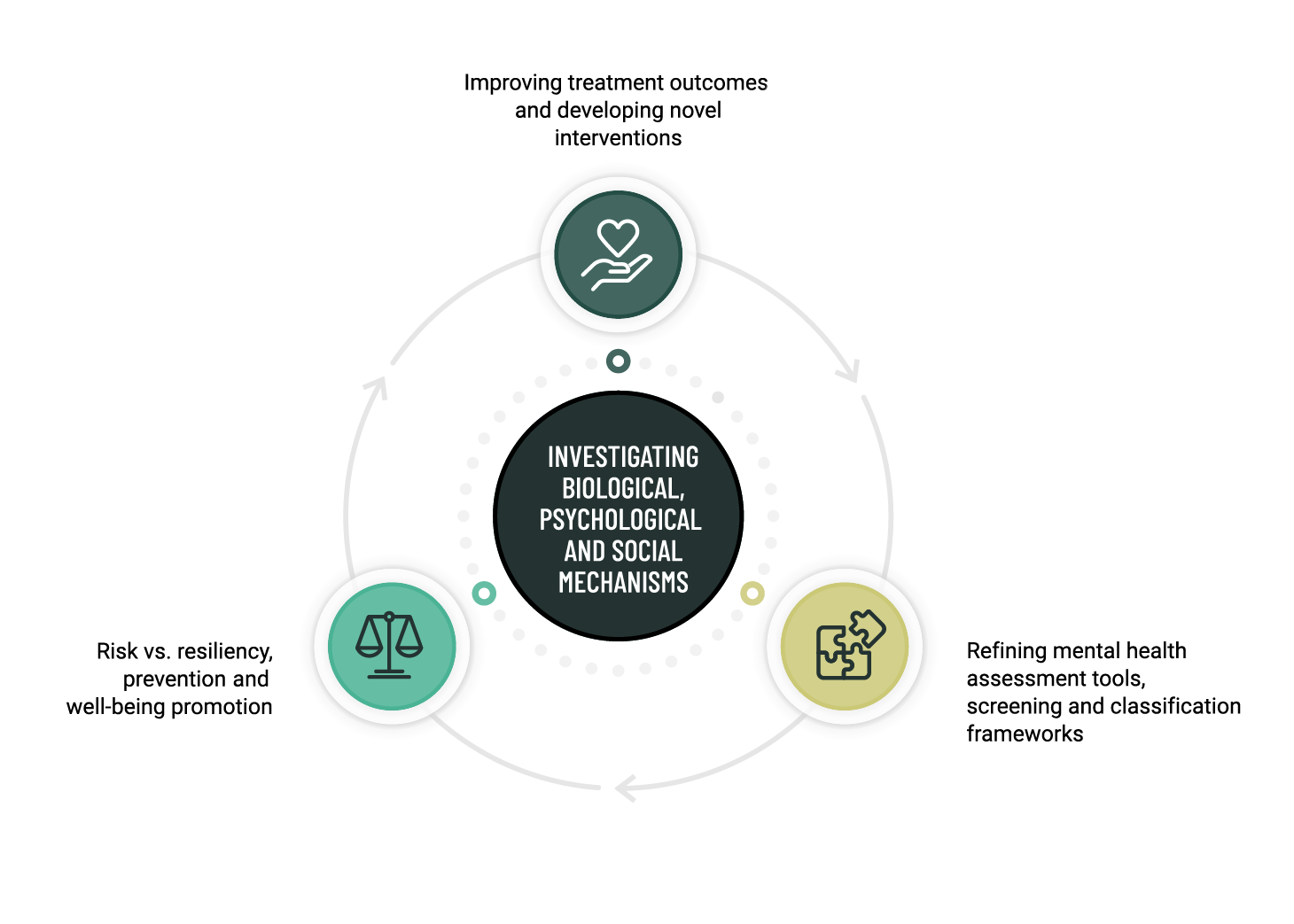
Our areas of specialization offer a framework to guide the Atlas Institute as it undertakes research in support of Veteran and Family well-being. The focus areas align with our mandate to build the Canadian evidence base on Veteran and Veteran Family well-being and the organization’s strategic zones of focus, which reflect our commitment to integrating the perspectives of Veterans and Veteran Family members in our work.
- Risk and protective factors
- Characteristics or events that increase or decrease the likelihood of a given mental health outcome
- Biological, psychological and social mechanisms
- Underlying factors that, alone or by interacting with one another, contribute to some aspect of mental health
- Screening and assessment
- Tools designed and used to identify the presence and/or severity of a particular mental health problem or illness
- Treatments, interventions and supports
- Pharmaceutical and non-pharmaceutical responses designed to improve, maintain and support well-being including but not limited to: medications, cognitive therapy, peer support and acupuncture
- Service design and delivery
- Features of health care services, including structure and function, access and use, navigation, and Veteran and Veteran Family experience
Mobilizing knowledge
Making research accessible and understandable to the people who need it is core to what we do at Atlas. Our research teams work closely with knowledge mobilization and implementation specialists to bridge the gap between academic knowledge and the diverse communities we serve, recognizing that the impact of our work lies not only in publishing evidence-based research, but also in effectively communicating it to Veterans, Families and other stakeholders. Through clear and accessible resources, presentations and engagement initiatives, we collaborate to foster awareness, inform policy discussions, and empower individuals to make informed decisions regarding Veteran and Family well-being.
Stories that INSPIRE
Stories that INSPIRE is a storytelling- and film-based research project led by Dr. Jenny Liu at the MacDonald Franklin OSI Research Centre. The project is funded by the Atlas Institute for Veterans and Families and supported by Mental Health Research Canada. The project invited Canadian Armed Forces (CAF) Veterans to share deeply personal accounts of transitioning out of military service, capturing both the challenges of social isolation and loneliness, and the strength found through resilience and community.
Drawing on interviews with Veterans from diverse backgrounds, service histories and transition experiences, the project highlights common emotional and social challenges following release, including loss of camaraderie, identity and belonging. It also emphasizes the healing role of peer support, purpose and reconnection.
Produced in collaboration with RADAR (Recovery Advocacy Documentary Action Research), the resulting film brings these stories to life with honesty and care, translating research into an accessible, human-centred tool for connection, education and advocacy.
This work sits within a broader, ongoing program of research examining the complex transition out of military service. The INSPIRE program is conducted in collaboration with Veterans Affairs Canada (VAC) and supported by multiple funders, including the Canadian Institutes of Health Research and the Chronic Pain Centre of Excellence for Canadian Veterans. VAC recently confirmed that the Stories that INSPIRE video will be adopted as an official onboarding tool for their employees, across all platforms, in both English and French. This milestone reflects the real-world uptake of Veteran-led storytelling and knowledge mobilization and highlights the strength of partnerships that support meaningful impact beyond the research context.
Insights on transition and adjustment for women Veterans of the Canadian Armed Forces
The Atlas Institute and the Canadian Legacy Project recently completed a study that looked at the impact transition from military service has on the mental health, well-being and adjustment of women Veterans in post-service life.
The study examined the transition experiences of women Veterans, their program and service use and needs, and factors that contributed to shaping positive or difficult transitions to post-service life. Participants comprised 170 women Veterans of the CAF who completed an online survey between October 24, 2024 and May 31, 2025.
Findings underscore the importance of mental health in women’s post-service lives, as many reported diagnosed conditions including posttraumatic stress disorder (PTSD), anxiety or mood disorders. These challenges, together with other difficulties identified related to adjustment — such as employment and financial stability — highlight the importance of sustained mental health support for women in a successful post-service adjustment. Other findings illustrate the high prevalence of harassment, discrimination and military sexual trauma experienced by women during service. Consistent with these experiences, participants emphasized the need for safe, trauma-informed supports, including peer and women-only groups. Ultimately, programs and services tailored to women’s needs may strengthen post-service adjustment and help facilitate successful transitions from military service for women Veterans.
These findings build on previous work and provide evidence for how programs, services and future research can more effectively support women Veterans and support their transition to post-service life.
We thank the Canadian Legacy Project for their generous funding, which contributed to the realization of this project.
Celebrating early-career researchers
The Clinical Research team at Atlas is committed to training the next generation of clinician-scientists who are working diligently to improve mental health outcomes among active-service and former members of the CAF and RCMP and their Families. Our team celebrated an incredible milestone for one of its members this past quarter: Dr. Jonathan Lieberman, a leader of our neurofeedback studies for the past several years, successfully defended his PhD thesis. Neurofeedback is a non-invasive treatment that trains people to self-regulate areas of the brain that may not be functioning well in the aftermath of trauma, using real-time feedback about brain activity from a computer-based program. As part of his defence, he detailed the methods of a neurofeedback clinical trial and highlighted optimal neurofeedback targets within the brain for addressing trauma-related symptoms.
Some of the findings from this research were recently published in NeuroImage: Clinical. The article, titled Contributions of the default mode and central executive networks during posterior cingulate cortex-targeted fMRI neurofeedback in PTSD revealed that for individuals with PTSD, neurofeedback targeting the posterior cingulate cortex (PCC) — a region of the brain involved in reflecting on oneself, recalling memories and processing emotions that can become overactive during trauma-related thoughts — resulted in more significant engagement of the default mode network, a neural network involved with self-referential processing and identity, than the central executive network, which plays a role in emotion regulation. These findings suggest distinct neural dynamics during PCC-targeted neurofeedback, which could help inform more tailored neurofeedback protocols among active members, Veterans and their Families, and highlight the importance of treating PTSD symptoms that are related to disruptions to one’s sense of self in the aftermath of trauma.
New study: Women Veterans’ reproductive and mental health
Many women who have served in the military or police force have experienced reproductive and mental health challenges. However, to date, research about these issues remains limited.
The Atlas Institute has partnered with the Centre for Military Women’s Research at Anglia Ruskin University to launch a new multinational study that will explore and compare the reproductive and mental health of women who served in the United Kingdom (UK) or Canadian militaries, the UK police or as uniformed members of the Royal Canadian Mounted Police (RCMP).
This research study is open for recruitment and we are looking for women living in Canada or the UK to take part in a short, one-time survey that asks questions on reproductive health and touches on topics such as fertility, contraceptive use, menopause, sexual health and mental health.
Participating in this study will generate insights about reproductive and mental health, helping to inform services and supports for women Veterans in both Canada and the UK.
Questions? Contact the Canadian research team at ✉️ research@atlasinstitute.ca
Improving military and Veteran mental health
Four articles authored or co-authored by Atlas researchers were recently published in a new special issue of the Journal of Military, Veteran and Family Health on the role of measurement based care and approaches to treatment resistance.
Toward a definition of treatment-resistant posttraumatic stress disorder: A systematic review
This review consolidated existing research on treatment-resistant PTSD, revealing significant variability in its definition across studies. The authors propose a dynamic reassessment of treatment resistance that considers adherence, treatment delivery, comorbidities and mechanisms for action.
Reimagining MAiD for psychiatric illness: Ethical dilemmas among Veterans, clinical realities, and the road ahead
This article examines how the expansion of medical assistance in dying (MAiD) in Canada to include mental illness as a sole underlying medical condition raises clinical, legal and ethical concerns, particularly for Veterans who are disproportionately affected by difficult-to-treat psychiatric conditions.
Barriers to and facilitators of measurement-based care in posttraumatic stress disorder treatment: A systematic review
This review identified a limited number of studies examining barriers to and facilitators of measurement-based care use and implementation for PTSD, highlighting gaps in the literature.
Augmenting evidence-based PTSD psychotherapy with neuroscientifically informed interventions: A mind-body-brain approach
This article describes how neuroscience informed treatment interventions, including neurofeedback, may improve outcomes of trauma-focused psychotherapies traditionally used to treat PTSD.
Getting involved in research at Atlas
Recruiting studies
Interested in participating in research? Research participation helps expand our understanding of Veteran and Family mental health and well-being and can support the improvement of treatments, programs and services. The Atlas Institute leads and supports research projects and new opportunities to participate, with varying levels of involvement, regularly become available. Check out a few of the studies currently looking for participants!
Led by Atlas
Women’s well-being in post-service life: Evaluating the psychological, social, and systemic factors associated with transition from the Canadian military
Note: Currently only open to women of the CAF in the process of transitioning out of the military or posted at a transition centre.
Led by Dr. Kate Hill MacEachern, Applied Research, Atlas Institute for Veterans and Families
To find out if you’re eligible to participate, please contact:
Understanding the mental and reproductive health of UK and Canadian ex-servicewomen
Led by Dr. Sara Rodrigues and Dr. Kate Hill MacEachern, Applied Research, Atlas Institute for Veterans and Families, in collaboration with Dr. Claire Hooks at Anglia Ruskin University
To find out if you’re eligible to participate, please contact:
Thriving after service: The prevalence and predictors of flourishing among military and RCMP Veterans
Led by Dr. André Lauzon, Applied Research, Atlas Institute for Veterans and Families
To find out if you’re eligible to participate, please contact:
The neural correlates of minority stress: Uncovering systemic oppression related to the intersectionality of identity with neuroimaging and machine learning
Led by Dr. Andrew Nicholson, Atlas Institute for Veterans and Families
Supported by Atlas
Studying the effectiveness and implementation of Sudarshan Kriya Yoga for Canadian Veterans with PTSD
Led by Sinai Health System — Bridgepoint Collaboratory for Research and Innovation
Brain measures linked to hyperarousal in PTSD using MRI imaging
Led by the University of Ottawa’s Institute for Mental Health Research at the Royal
Other ways to get involved
The Atlas Institute recognizes the importance of including different experiences and perspectives in our various projects. We believe the voices of our lived experience community are vitally important to the work we do and invite you to participate in our projects, including research projects, through surveys, panels, webinars and town hall events and more.
Latest publications
Sexual and Reproductive Health Recommendations for Women and Nonbinary Young Adults With Early Psychosis: A Qualitative Study
2026-07-08
Hannah Kearney, Juveria Zaheer, Zakia Hussain, Julia France, Ananka Rodriguez, Shakked Lubotzky-Gete, Suze Berkhout, Robert Dmytryshyn, Sheila Dunn, Renu Gupta, Fardous Hosseiny, Frank Sirotich, Sophie Soklaridis, Aristotle N. Voineskos, Simone N. Vigod, and Lucy C. Barker
Psychiatric services
Read the paper
Violence on the self: Exploring the intersection of trauma and identity among sexual and gender minorities from a neurobiological and developmental perspective to advance our understanding of PTSD, moral injury, and dissociation symptoms
2026-07-01
Andrew A. Nicholson, Magdalena Siegel, Ally H. Villeneuve, Lorenzo Lucherini Angeletti, Negar Fani, Taylor Hatchard, Georg Northoff, Ruth A. Lanius, Mina Pichtikova, Niki Hosseini-Kamkar, Kristen L. Eckstrand
Neuroscience & Biobehavioral Reviews
Read the paper
Beyond the uniform: An international call for a mental healthframework that addresses the needs of military and Veteranfamilies during transition
2026-06-24
Ashlee Mulligan, Laryssa Lamrock, Fardous Hosseiny, Jason Alves, Marie Manteuffel, Joris Haagen, Anthony Nazarov, Matt Fossey and MaryAnn Notarianni
Journal of Military, Veteran and Family Health
Read the paper
Research Compass newsletter
Research Compass is the Atlas Institute’s regular newsletter about our Veteran and Family well-being research.
In each issue, you can expect a diverse range of content, including research highlights, links to access our latest results, a behind-the-scenes look at how we conduct research and updates on ongoing projects. We will also provide information about upcoming events, training opportunities and resources that can further enhance your understanding and engagement with research.
Explore our research studies
Join our recruiting studies and help turn your experiences into learnings that inform treatments and policies. You can also access information about the processes and the results of our non-recruiting and completed studies.
